UCF Physicist Wins NASA Grant to Design 25-Spacecraft Telescope Concept
Anish Roshi Damodaran will spend nine months studying PHOENIX, a virtual telescope that links multiple spacecraft to observe planet formation in detail current observatories cannot achieve.
By Aiko Brooks ·
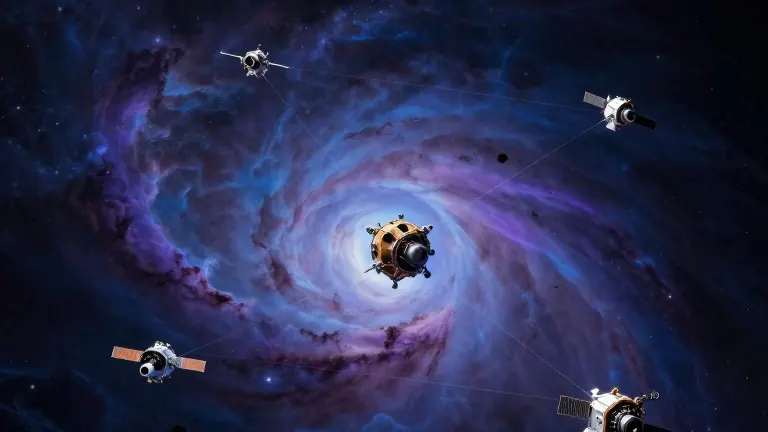
A new NASA grant will fund a UCF professor's study of a virtual telescope designed to resolve structures in space that single-dish observatories cannot see. The project, known as PHOENIX, proposes linking up to 25 spacecraft using advanced photonic technologies to function as a single, larger instrument.
Anish Roshi Damodaran, a professor in the Florida Space Institute and the College of Sciences, is one of 18 researchers selected for Phase I of NASA's 2026 Innovative Advanced Concepts program. The nine-month award provides $175,000 to evaluate the feasibility of the concept. Damodaran previously led radio astronomy operations at the Arecibo Observatory before its collapse in 2020.
The core challenge for the PHOENIX concept is resolution. Current facilities can detect cold gas and dust associated with star and planet formation, but they struggle to directly resolve the critical structures where these processes occur. A single telescope large enough to provide that resolution would face severe launch constraints, making a distributed system of smaller satellites a potential alternative.
Damodaran's team will spend the next nine months developing a detailed mission architecture rather than building the observatory itself. The study aims to identify critical enabling technologies, evaluate performance requirements, and assess technology readiness levels. The goal is to determine if the vision is technically achievable for future implementation.
The project brings together expertise in astronomy, photonics, and space instrumentation from UCF and NASA's Jet Propulsion Laboratory. Collaborators include Peter Delfyett, a Pegasus Professor in the College of Optics and Photonics, along with Guifang Li and Stephen Eikenberry. The team also includes Julie Brisset from the Florida Space Institute, Yan Fernandez from the College of Sciences, and Jacob Kooi and Jonathan Kawamura from JPL.
Damodaran noted that the process of developing the concept feels like undertaking a second doctoral dissertation. It requires questioning assumptions, exploring alternative approaches, and identifying technology gaps. He described the opportunity to explore such a bold idea at its earliest stage with NASA's support as professionally and personally inspiring.
If the PHOENIX concept progresses, it could allow scientists to observe planet formation in protoplanetary disks around young stars. The system would resolve structures on scales comparable to the inner solar system. This would enable researchers to track how water, ice, molecular gas, and dust assemble into planets and identify the conditions that lead to potentially habitable systems.
The concept also offers insights into star formation within dense, dust-enshrouded environments. By combining high-resolution imaging with spectroscopy, the observatory could analyze how turbulence, gravity, and gas dynamics interact. On a larger scale, observations of distant galaxies could help researchers examine how supermassive black holes and star formation have influenced galaxy evolution over billions of years.
NASA's NIAC program supports aerospace concepts through progressive phases. Eligible Phase I recipients can propose for Phase II, which offers up to $750,000 for two years of further development. Phase III provides up to $2 million for another two years, with the goal of transitioning high-impact concepts to other government agencies or commercial partners. NASA plans to make six to eight Phase II awards and one Phase III award annually.