PNW voters navigated varied poll hours and ID rules to decide key races
Washington, Oregon, Idaho, Alaska, and Hawaii each used distinct voting schedules and identification requirements on Election Day 2026.
By Aiko Brooks ·
Voters across the Pacific Northwest completed their ballots under a patchwork of local rules on Tuesday, November 3, 2026. The five states in the region, Washington, Oregon, Idaho, Alaska, and Hawaii, each maintained different polling hours and identification standards. These logistical differences shaped the final hours of the midterm election. Results are now in for most of the region's high-stakes races.
Polling places in Washington opened at varying times and closed at 8 p.m. The state had no Senate race and no governor race on the ballot. Voters focused on other federal and local offices. The Associated Press reported that Marie Gluesenkamp Perez won the Washington U.S. House election in District 3. Democrats held that seat in a race Ballotpedia identified as a battleground.
Oregon polls operated from 7 a.m. To 8 p.m. On Election Day. The state faced an open seat for U.S. Senate and an open seat for governor. Ballotpedia noted that Democrats won 20 of the 35 U.S. Senate races nationwide. The Associated Press reported that Abdul El-Sayed won Michigan’s open U.S. Senate seat, becoming the first Muslim elected to the chamber. This win preserved a crucial Democratic seat in the party’s fight for Senate control.
Idaho polls were open from 8 a.m. To 8 p.m. The state had a Senate race with incumbent Jim Risch and a governor race with incumbent Brad Little. Ballotpedia reported that Republicans won 13 of the 35 U.S. Senate races as of 9:05 AM ET on November 4. Two Senate races remained uncalled. Both of those uncalled seats were previously held by Republicans. One of those uncalled races was in Alaska.
Alaska polls ran from 7 a.m. To 8 p.m. The state had a Senate race with incumbent Dan S. Sullivan and an open governor race. Reuters reported that the outcome of the U.S. Senate race in Alaska was unclear on Wednesday. The state uses an unusual voting system. A legal challenge by the Trump administration added to the uncertainty. Reuters noted it could be weeks until a result is known in Alaska. This delay is part of the two Senate races that remained uncalled as of the morning of November 4.
Hawaii polls closed earlier than the other four states, shutting down at 7 p.m. The state had no Senate race but did have a governor race with incumbent Joshua Green. Ballotpedia reported that Democrats won 22 of the 36 gubernatorial races nationwide as of 4:17 PM ET on November 4. Republicans won 12. Two governor races remained uncalled. One of those uncalled races was previously held by a Democrat, and the other by a Republican.
The United States Postal Service played a critical role in the election as it delivered millions of mail-in ballots. The Associated Press noted that more than 59 million people had cast ballots before Tuesday. This figure surpassed early-voter turnout from the 2022 election. The Postal Service handled the final leg of delivery for these mail ballots. Many states, including those in the Pacific Northwest, rely heavily on mail-in voting. The timely delivery of these ballots ensured that voters who mailed their ballots early could still have their votes counted on Election Day.
Voters had to navigate specific identification rules to cast their ballots in person. Each state in the region has its own laws regarding what form of ID is required. Some states required a photo ID, while others accepted a range of documents. The Federal Election Assistance Commission provides a tool called vote.gov. This site helps voters find their polling place and understand their state's specific rules. It lists poll hours, ID requirements, and mail ballot deadlines. Many voters used this resource to confirm their eligibility and location before heading to the polls.
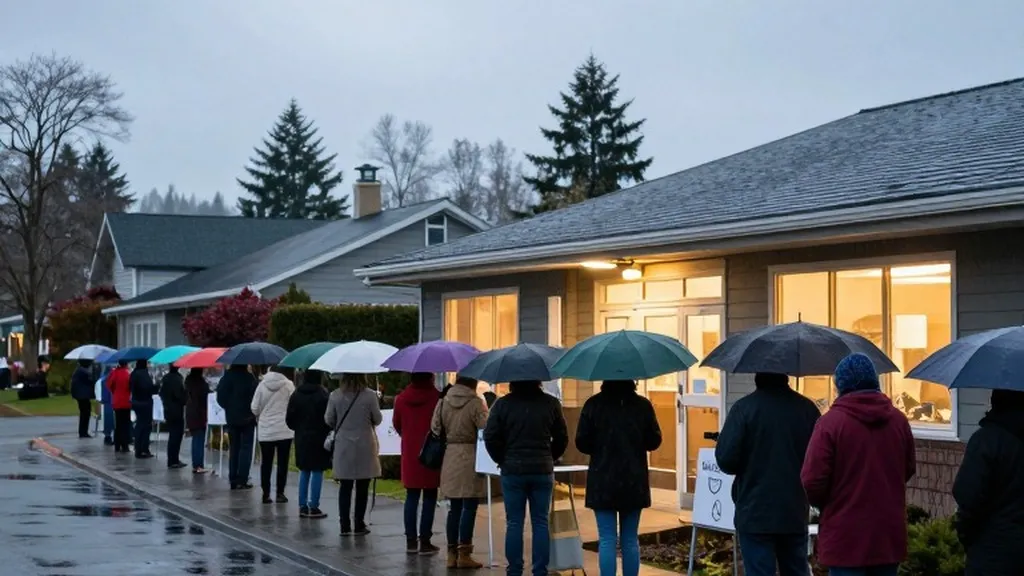
Standing in line was a common experience for voters in all five states. The Associated Press reported that the election served as a referendum on President Donald Trump's second term. Voters were angry over high prices and the war in Iran. They were also concerned about government corruption. These issues drove high turnout. The AP Voter Poll found that three-quarters of voters say the economy is not so good or poor. About 8 in 10 said inflation has caused a severe or moderate financial hardship. This frustration translated into long lines at polling places across the region.
The results of the election set up a divided government at the federal level. Democrats won control of both the U.S. House and the U.S. Senate. In the House, Democrats won 233 seats to Republicans 138 as of 4:12 PM ET on November 4. In the Senate, Democrats won 20 seats to Republicans 13. This shift in power means that the new Congress will have the ability to check the White House. President Trump has warned of gridlock ahead. He has threatened to use the power of the presidential veto to strike down Democratic agendas. This dynamic will likely define the next two years of federal politics.
In the Pacific Northwest, the election results reflect the national trend. Democrats made gains in several states. The Associated Press reported that Democrats won or retained full control of both chambers of the legislatures in several battleground states. This includes states where Democrats previously shared power. The wins put pressure on the party to answer to an electorate angry over the rising cost of living. State governments shape policies affecting everyday lives, including tax rates, school choice, and education funding. The new Democratic majorities in state legislatures will have a direct impact on these issues.