Netanyahu orders full closure of West Bank after Hebron checkpoint shooting
Two Israeli soldiers died and three others were wounded in a gun battle on Oct. 23, prompting Prime Minister Benjamin Netanyahu to impose a total cordon on the region.
By Aiko Brooks ·
Two Israeli soldiers died and three others were wounded in a terrorist shooting attack near Hebron on Oct. 23, leading Prime Minister Benjamin Netanyahu to order a full closure of the West Bank.
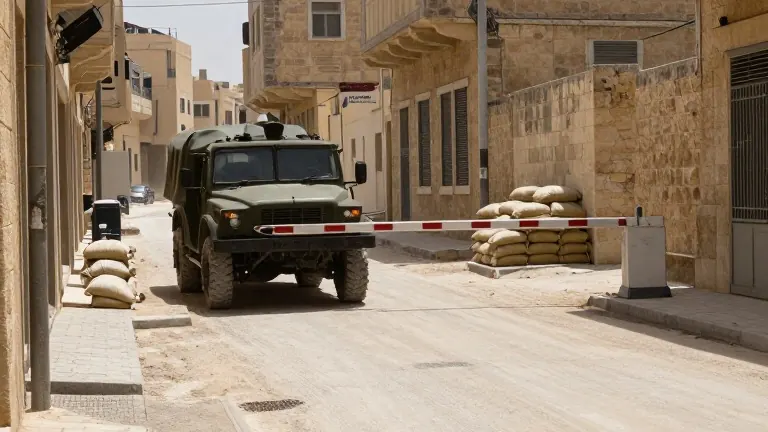
The attack occurred around 7:30 a.m. near the Yehuda Junction. Two Palestinian gunmen, both 27 years old and residents of Hebron, arrived at a temporary military checkpoint by car. According to an initial military investigation, they intended to reach Route 35 to attack Israeli civilians but realized they could not pass the checkpoint. Armed with an M16 rifle and a handgun, they exited their vehicle and opened fire on troops stationed at the exit, using nearby buildings for cover.
The IDF identified the slain soldiers as Staff Sgt. Ron Yonatan Roytman, 23, of Ashkelon, and Sgt. Yuval Shai Svilem, 20, of Hod Hasharon. Both served in the Home Front Command’s Ari Battalion. Roytman was a squad commander, while Svilem was a combat soldier. Three other members of the battalion were wounded and evacuated to hospitals in Jerusalem for treatment.
A gun battle lasting more than 20 minutes ended when the terrorists were killed by soldiers from the Ari Battalion and an officer from the Paratroopers Brigade’s 101st Battalion who rushed to the scene. Military investigators later found a large quantity of ammunition in the gunmen's vehicle, indicating a plan for a larger-scale attack. Hamas claimed responsibility for the incident. The IDF and the Israeli Security Agency are currently investigating whether the two acted independently or as part of a broader network.
In response, Netanyahu imposed an immediate cordon on Hebron and instructed security forces to close the West Bank. The IDF stated that Hebron, a city of over 200,000, is under a full siege with no one permitted to enter or leave. Troops are operating at the homes of the two terrorists and additional suspects while stepping up arrest operations. The military noted that while there was no specific intelligence warning of this attack, forces were already on heightened alert ahead of the Oct. 27 election.
IDF Chief of Staff Lt. Gen. Eyal Zamir described the event as a serious terrorist attack. He stated that the rapid response by the soldiers prevented further harm to civilians and security forces. Zamir instructed the Central Command to prepare for additional troop reinforcements. Netanyahu said in a statement that forces are operating with increased strength to thwart terrorism and are carrying out extensive waves of arrests. He vowed that Israel would pursue Hamas terrorists everywhere and at all times.
Rabbi Howard Cove of Beiteinu, a nondenominational traveling shul in the Delaware Valley, said he trusts the IDF and Mossad to root out sources of disruption. He suggested that controlled house-to-house operations might be necessary to prevent another Gaza scenario. However, Cove emphasized that justice must be conducted legally and responsibly. He expressed concern that Israelis who endanger Palestinians should also be arrested.
The attack comes as the IDF reinforces Judea and Samaria with an additional regular brigade for the election period. The West Bank has seen rising violence for months, particularly during the olive harvesting season. The United Nations recorded at least 160 Israeli settler attacks in the first two weeks of October. Many of these occurred under the protection of or with the participation of Israeli forces. On Oct. 16, masked settlers attacked farmers near the village of Abu Falah, throwing stones and setting trees on fire.
Cove noted that the event is a reminder that the government must keep the people safe. He stated that he does not have a specific prediction on how the killings will impact the elections, but he believes security remains the primary issue for Israeli voters next week.