Cuba embargo vote splits UN
Support for the annual resolution dropped sharply as the Trump administration pushed for a tougher economic line.
By Matthew Qureshi ·
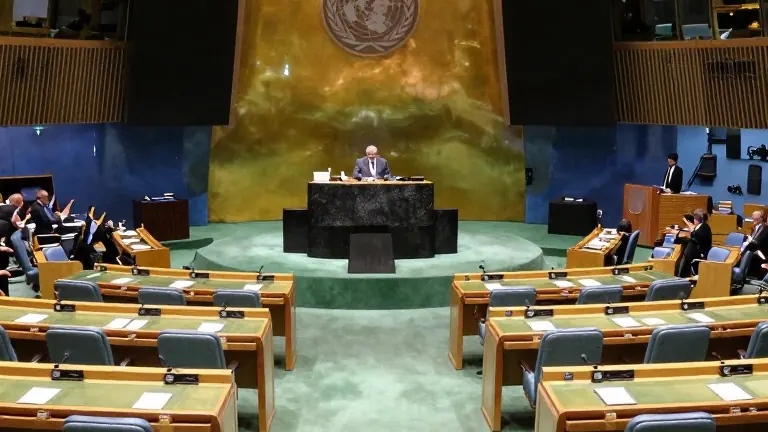
The United Nations General Assembly voted 130 to 17 on Wednesday to condemn the United States economic embargo of Cuba, a measure that has passed for 34 consecutive years. The result marked a distinct shift in international alignment, as 25 nations abstained from the vote, a large increase from the 12 abstentions recorded the previous year. This change reflects a growing hesitation among member states to back the resolution unconditionally as Washington intensifies its pressure on Havana.
The decline in affirmative votes is the most consequential aspect of the outcome. Last year, more than 160 countries supported the measure. This year, that number fell to 130. Western nations including Germany, Italy, and Latvia refrained from voting for the first time in the 34-year history of the resolution. Other states that cast negative votes for the first time included Bosnia, Colombia, Costa Rica, Ecuador, Lithuania, Morocco, North Macedonia, Paraguay, and Slovenia. These moves signal a fragmented global stance on the long-standing trade restrictions.
Washington framed the vote as a strategic opportunity to weaken the political standing of the Cuban government. U.S. Ambassador to the U.N. Mike Waltz told member nations that their vote was the only barrier preventing the regime from claiming a propaganda victory. He described the government as a corrupt, kleptocratic communist entity that relies on the assembly for political support. The U.S. position aligns with the administration's recent efforts to force political changes in Cuba through increased economic pressure, including threats of military intervention by President Donald Trump.
The procedural vote was accompanied by a sharp public confrontation between the two delegations. On Tuesday, U.S. Ambassador Mike Waltz and Cuban Foreign Minister Bruno Rodríguez engaged in a shouting match on the General Assembly floor. Rodríguez approached the podium while Waltz was speaking, calling him a liar and requesting a point of order. Waltz responded by telling the Cuban minister to step back, asserting that he was not being intimidated in the United States. Security personnel and staff had to intervene to separate the two diplomats during the exchange.
The tensions extended beyond the main chamber. Waltz accused a member of the Cuban delegation of attacking an American diplomat who was filming him. He stated that Secretary of State Marco Rubio had ordered the official sent home, a decision the State Department confirmed on Wednesday. Cuban Foreign Minister Bruno Rodríguez criticized the U.S. government for using crude language to justify its economic aggression. He emphasized that the blockade, not Cuba, represents the primary threat to regional stability.
The diplomatic friction follows a week of heightened activity. A similar interaction occurred between Waltz and his Cuban counterpart, Ernesto Soberón Guzmán, outside a U.S.-hosted panel featuring Cuban dissidents. This sequence of events marks a departure from traditional diplomatic decorum at the United Nations. The U.S. embargo, first imposed in 1960 after Fidel Castro’s revolution, has long defined economic relations between the two nations.
The current phase of contention is driven by new U.S. policies. In late January, President Trump announced tariffs on any country selling or providing oil to Cuba. This move effectively cut off fuel supplies to the island. The resulting energy shortage has led to widespread power outages. These outages disrupt basic services, including water supply, internet, and telephone systems, deepening the financial and social strain on the Cuban population.