Spain's Rail Network Faces Second Fatal Crash This Year
A collision near Urda killed 68 people, intensifying scrutiny of high-speed rail safety four weeks before a national election.
By Matthew Qureshi ·
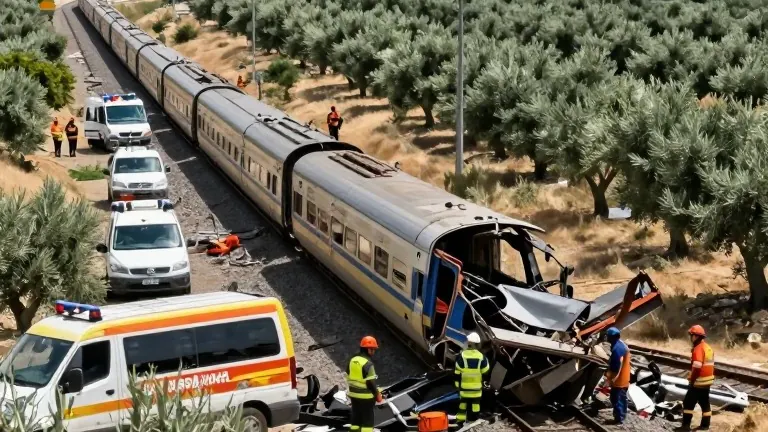
A high-speed train collision near Urda, Spain, killed 68 people on Wednesday, marking the second deadly rail disaster in the country this year. The incident occurred when a RENFE train struck a stationary IRYO train from behind at 8:53 a.m. local time. The crash site, located in the central province of Toledo, was lined with olive groves and became the focus of a massive rescue operation involving firefighters, police, and soldiers.
Spanish Prime Minister Pedro Sánchez visited the site after regional authorities confirmed the death toll surpassed 60. He declared three days of national mourning starting Thursday. Sánchez stated that the government needs to reinforce safety measures to rebuild public trust in the high-speed rail network. He described it as unacceptable for Spain to experience two such accidents in a single year.
Transport Minister Óscar Puente identified human error as the cause of the crash. He explained that a computer malfunction at 8:30 a.m. disabled the security system on a 63-kilometer stretch of track, forcing all trains to stop. The IRYO train halted near Urda, while the RENFE train stopped 25 kilometers behind it. Minutes later, the central command center issued an order for the RENFE train to resume movement without speed restrictions, despite an active stop signal. Puente said the engineers were not at fault for following the instruction.
Spain's high-speed rail system ranks second in the world for track mileage, behind only China. The network had operated without a fatal crash for more than three decades until the January incident in southern Spain, where 46 people died when a train jumped the tracks and hit another. The system carried 45 million travelers last year, including millions of international tourists. The market for high-speed rail in Spain was liberalized in 2021, allowing private operators like the Italian-owned IRYO to enter the sector in 2022.
The crash lands four weeks before Spain's first national election since 2023. Polls suggest Prime Minister Sánchez faces a challenging path to reelection. His Socialist party had hoped to capitalize on voter discontent regarding housing costs and high rents. Sánchez posted on social media an hour before the crash news broke, stating there were many reasons to be optimistic about the country. The accident complicates his campaign as he must address rail safety concerns alongside debates over migration policy and corruption allegations.
Political rivals are already positioning themselves. Alberto Núñez Feijóo, leader of the Popular Party, demanded a full investigation and cancelled his party's campaign events for the day in respect for the victims. Santiago Abascal, leader of the far-right Vox party, used the tragedy to criticize the government, calling it a criminal organization and promising to work until it faces trial. Abascal expressed rage over what he described as the despair and betrayal experienced by Spanish citizens.
Workers began using cranes to move damaged train parts late on Wednesday. The rescue effort continued through the day with hundreds of emergency personnel on site. The investigation will focus on why the central command center issued the order to move the RENFE train while the security system remained offline and the stop signal was active.
More Business · Consumer Watch · Report a business · Got a Story?