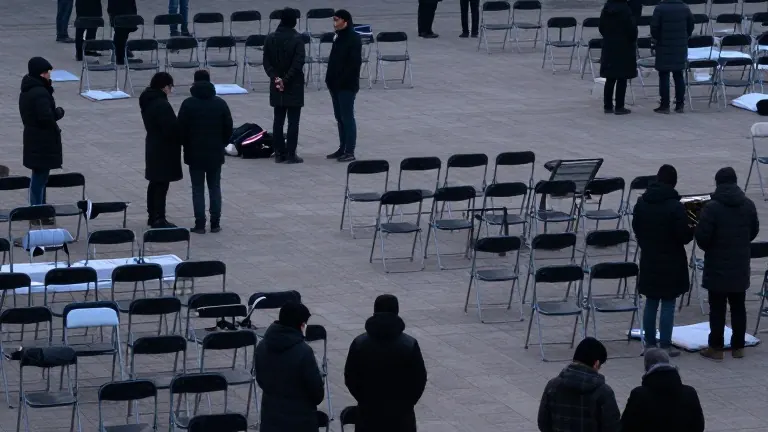
Spain faces second deadly train crash ahead of election
A collision in central Spain killed 68 people, forcing the government to investigate command errors while the prime minister prepares for a vote in four weeks.
By Matthew Qureshi ·
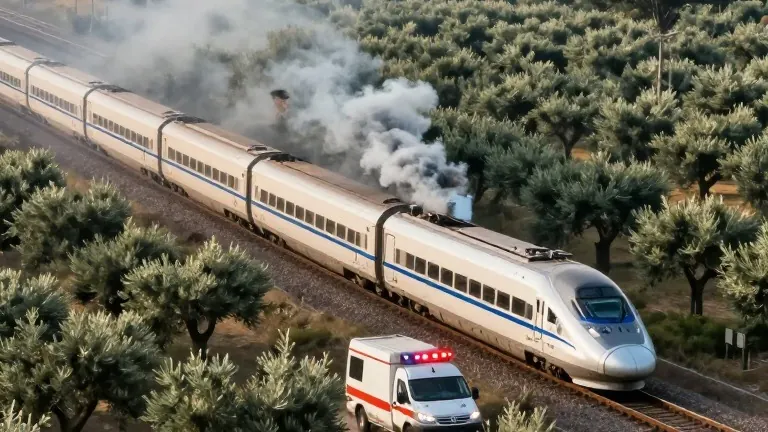
Spain is grappling with a second fatal high-speed rail disaster this year, an event that threatens to overshadow the upcoming national election. A train operated by the state-owned RENFE struck a stationary privately operated IRYO train from behind on Wednesday. The impact occurred in the central province of Toledo, killing 68 people and injuring dozens more who were transported to local hospitals.
The collision happened in a rural area lined by olive groves. Regional authorities confirmed the death toll after emergency workers, including firefighters, police, and soldiers, spent the day rescuing survivors and recovering bodies. Workers used cranes late in the day to move parts of the damaged trains. This crash marks the second time in 2026 that Spain's high-speed rail network has suffered a deadly accident.
The timeline of events leading to the crash reveals a sequence of technical failures and command decisions. At 8:30 a.m., a computer malfunction caused a security system covering a 63-kilometer stretch of track to fail. All trains on that section stopped. The IRYO train halted near the town of Urda, while the RENFE train stopped 25 kilometers behind it. Minutes later, a central command center issued an order for the RENFE train to resume running without speed restrictions. The train moved and collided with the stationary IRYO train at 8:53 a.m.
Transport Minister Óscar Puente stated that the crash was caused by an inexplicable order from the command center. He said the train engineers were not to blame. Puente noted that the RENFE train should not have been told to move while a stop signal was still active. If it had moved, it should have been ordered to proceed at a reduced speed. He pledged that the government would investigate the incident and improve safety measures.
Prime Minister Pedro Sánchez visited the site and declared three days of national mourning starting Thursday. He acknowledged that the rail system, which carried 45 million travelers last year, had lost public trust. Sánchez said, "It is not acceptable for a country like Spain to endure two high-speed train accidents in the same year." He promised to reinforce safety to rebuild confidence in the network.
The timing of the crash complicates Sánchez's political position. He called for early elections earlier this month, hoping to capitalize on voter discontent regarding housing costs and high rents. Polls indicate he faces a challenging race in Spain's first national election since 2023. The disaster adds to existing attacks from right-wing parties regarding migration policies and corruption accusations against his party and his wife, which both deny. Sánchez had posted on social media just an hour before the crash news broke, writing that there were many reasons to be optimistic about the country.
Political rivals are already shaping their responses. Alberto Núñez Feijóo, leader of the conservative Popular Party, demanded a full investigation and canceled his party's campaign events for the day. He said, "This is the moment to respect the dead, the injured and their families." Santiago Abascal, leader of the far-right Vox party, used stronger language. He described the event as another tragedy and promised to work until the current government was held accountable in court.
The incident highlights the recent changes in Spain's rail sector. The country only liberalized high-speed rail service in 2021. Italian company IRYO began operations the following year. Both crashes this year involved one RENFE train and one IRYO train. The system, which ranks second in the world in track mileage behind China, had not suffered a deadly crash in over three decades until this year.