Deer Control Costs Hit $91m as Only South Australia Meets National Targets
A leaked government report reveals that feral deer are expanding across Australia, with South Australia the only jurisdiction to successfully reduce their numbers and impacts.
By Matthew Qureshi ·
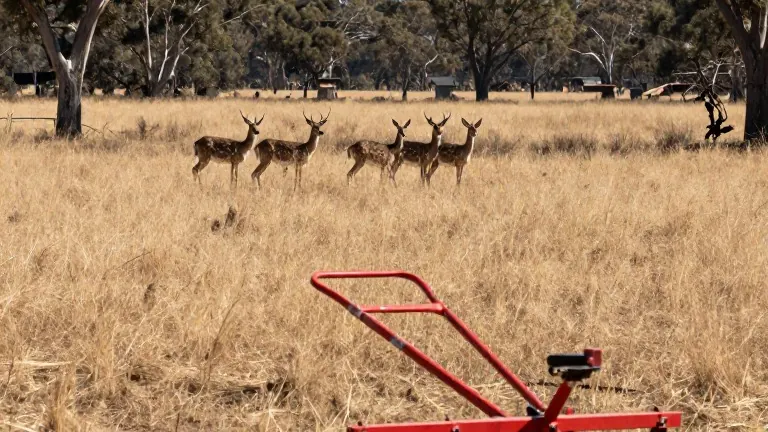
Feral deer are costing Australia $91 million annually in production losses and management time, according to a leaked national report that warns the species is becoming the country's next major invasive pest. The document, prepared by the National Vertebrate Pest Coordinators, assesses the five-year period from 2020 to 2025 and finds that most governments are failing to control the spread of six established deer species.
The report uses a traffic light system to grade state and territory performance across four categories. South Australia received a green rating in all four areas, marking it as the only jurisdiction to demonstrate a decrease in deer abundance, distribution, and environmental impact. In contrast, New South Wales and Tasmania received red ratings in every category. Queensland and the Australian Capital Territory each received three reds and one yellow. No other jurisdiction achieved a single green score.
South Australia's success stems from a statewide eradication plan launched in 2022. Andrew Lowe, director of the Environment Institute at the University of Adelaide, noted that the state took decisive action after an estimate showed annual agricultural damage of $36 million could rise to $241 million by 2031. Since beginning a $4 million eradication program, Lowe said deer populations in South Australia have declined significantly, though they are now seeking refuge in urban fringes where culling is more expensive.
Lowe estimates that functional eradication in South Australia will require an additional $10 million over the next decade. He argued that this cost is manageable compared to the projected $240 million loss if inaction allows populations to rebound. "So $10m versus $240m, do the math," Lowe said.
Outside South Australia, the situation is deteriorating. The report notes that deer have increased in both numbers and territory, encroaching on major cities. Reece Pianta, advocacy manager for the Invasive Species Council, described the report as evidence of long-term systemic underfunding. He stated that deer lack the public recognition of other invasive species but are equally damaging. Pianta called deer "the next feral pig," warning that intervention now could still contain or reverse their spread.
Euan Ritchie, a professor at Deakin University and president of the Australian Mammal Society, expressed that he was "not at all" surprised by the findings. He said the report shows governments are failing to invest enough in control measures, which have severe impacts on agriculture, native wildlife, road safety, and culturally significant sites. Ritchie described the outcome as the result of sustained failure to act sufficiently.
The report covers six feral deer species: chital, fallow, hog, red, rusa, and sambar. Populations are highest in south-eastern Australia, with smaller, localized groups in South and Western Australia and the Northern Territory. The assessment period included increased urban encounters, such as an incident where two men were fined after getting lost in the bush following a deer encounter while nude sunbathing.
The next phase of national strategy will depend on whether other states follow South Australia's model. Pianta said that while continental eradication is unlikely, state-level containment is achievable. The report suggests that without prompt action, the economic and environmental costs will continue to climb across the country.
More Business · Consumer Watch · Report a business · Got a Story?