Controller Error Cited in Toledo Train Crash
Minister Puente blames a control center mistake for the collision that killed 69, while unions cite understaffing and aging safety technology.
By Aiko Brooks ·
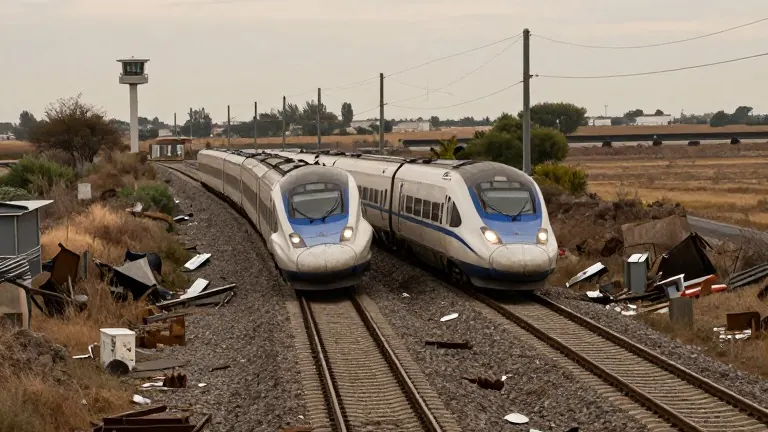
Spain's high-speed rail network, the second-largest in the world, has suffered its second fatal collision this year after a crash in Toledo province on Wednesday left 69 people dead.
Transport Minister Oscar Puente attributed the disaster to a decision made by a traffic controller in Madrid. The government timeline indicates the LZB digital safety system failed at 8:31 a.m. on Wednesday. This forced 16 controllers at the Madrid post to manually monitor a 63-kilometer stretch of track where two trains were operating. At 8:36 a.m., a controller authorized a state-owned RENFE train to restart at normal speed. A privately operated IRYO train 25 kilometers away attempted to restart but failed. The collision occurred at 8:53 a.m., with initial findings suggesting the RENFE train traveled between 160 and 200 kilometers per hour.
Puente described the controller's judgment as erroneous and inexplicable during a news conference on Friday. He stated that the information points to a mistake in the control center, though he added he would not use a worker as a shield.
Railway unions challenged the minister's assessment, arguing that the error resulted from systemic issues. Raquel Ayllon, spokesperson for the SCF union, said the minister is blaming a worker operating under poor conditions. She noted that human error is less surprising than the regular failure of safety systems.
The crash follows a January incident on the same Madrid-Seville line that killed 46 people. Prime Minister Pedro Sanchez visited the site near Urda on Friday, calling it unacceptable for a country with such a strong rail network to suffer two major accidents in one year. The liberalization of rail service increased passenger numbers from 35 million in 2019 to 49 million in 2024, according to the National Markets and Competition Commission.
Union officials point to the age of the infrastructure. Diego Martin of the SEMAF union said the three-decade-old LZB system should have been replaced. Puente acknowledged the system went offline 170 times this year due to vandalism, maintenance, and weather. He defended his ministry by noting it increased controller staff from 1,000 in 2016 to 1,700 currently.
Police with sniffer dogs continued clearing the wreckage on Friday. Investigators removed the trains' black boxes late Thursday and handed them to the Civil Guard. A judge is leading the legal investigation. Thirty-nine people remained hospitalized, and only five bodies had been identified as of Friday.
Seventy families have filed missing persons reports. The death toll may rise as regional authorities continue to assess the wreckage.