1,000 Songs: The 2001 iPod That Redefined Portable Music
Twenty-five years ago, Apple’s $399 device packed a gigabyte-era library into a card-sized form factor, challenging giants like Sony with a new standard for digital audio.
By Noor Haddad ·
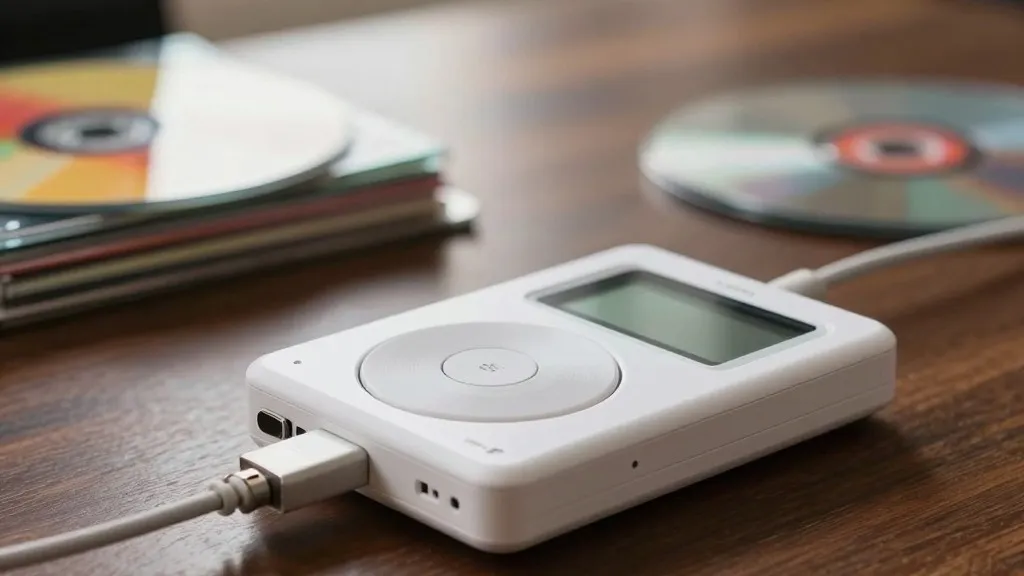
The figure that defined the original Apple iPod was 1,000. That was the number of songs the device could hold, a capacity that allowed users to carry their entire music library in their pockets for a price of $399. On this day in 2001, Apple CEO Steve Jobs unveiled the gadget, marking a significant milestone in consumer electronics history. The launch occurred during a period when the company was successfully revitalizing its brand, moving beyond its earlier beige aesthetic into the Mac OS X era with established products like the iBook and iMac.
Jobs positioned the iPod as the missing piece in a broader digital ecosystem. He envisioned the Mac as the central hub for a user's digital lifestyle, connecting devices such as cameras and DVD players. While acknowledging competitors like Sony, Creative, and Sonic Blue, Jobs argued that none had yet found the correct formula for digital music. At the time of the announcement, the market offered four primary portable options: CD players, MP3 CD players, flash-based players, and hard disk-based units. Apple selected the hard disk approach as its entry point into the market.
The device’s physical design was a direct result of Toshiba’s development of a new ultra-compact hard drive. Measuring just 1.8 inches in diameter and 0.2 inches thick, this component allowed the iPod to match the size of a standard deck of cards at 2.4 by 4 by 0.78 inches. Weighing only 6.5 ounces, it was lighter than most cell phones of the era. Despite its small footprint, the player included advanced features such as 20-minute skip protection and fast file transfer capabilities.
Connectivity was a major differentiator for the new product. The iPod was the first music player to utilize a FireWire 400 connection, which Jobs claimed could transfer an entire CD’s worth of data in five to 10 seconds. This was a stark contrast to USB connections of the time, which could take up to five minutes for the same task. Filling the device with its full 1,000-song capacity would take roughly 10 minutes, compared to five hours on competing USB-based players. The unit also featured a rechargeable lithium-polymer battery capable of 10 hours of continuous playback.
User interface design emphasized simplicity and tactile feedback. Jobs highlighted the device’s minimal aesthetic and its single-hand controls, which included an accelerated scroll wheel with a piezoelectric clicker. This allowed for rapid navigation by artist, playlist, or song. During the demonstration, the first track played was 'Building a Mystery' by Sarah MacLachlan. The launch was synchronized with the release of iTunes 2, which introduced MP3 CD burning and an Auto-Sync feature that kept the portable player aligned with the user’s library on their Mac.
The first iPhone did not arrive until early 2007, more than five years after the iPod’s debut. The two devices coexisted in Apple’s product lineup for over a decade before the iPod’s relevance gradually diminished. The final model, the 7th-generation iPod Touch, was released in May 2019. Although the product line was left without updates for several years, Apple officially discontinued it in May 2022, closing the chapter on a device that had dominated the portable music market for a quarter of a century.
Source: Tom's Hardware