House Control Likely Shifts as Ad Spending Surges in 70 Districts
Democrats hold a 10-point polling lead, driving over $10 million in final-week ad buys across key swing districts.
By Rebecca Foster ·
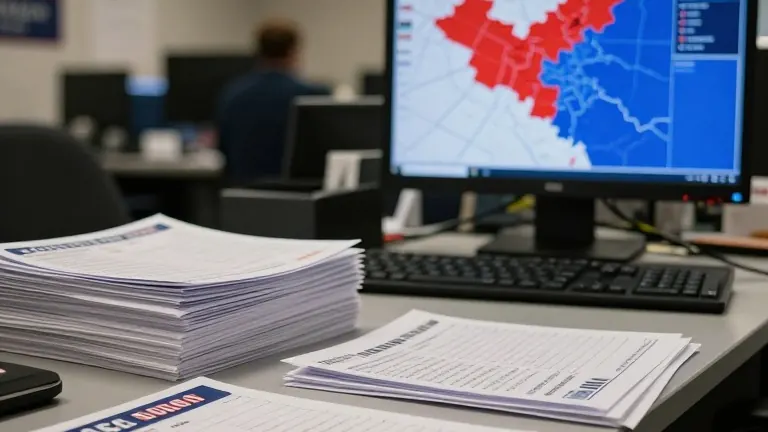
Democrats are on track to take control of the U.S. House of Representatives in the November 3 midterm elections. A new analysis from NPR indicates that the final week of campaigning is focused less on preventing a Democratic takeover and more on determining the size of their majority. The current House composition includes a slim Republican lead of 218 seats to 214. That margin appears unlikely to survive the upcoming vote. The Cook Political Report now lists Democrats as favorites in 220 districts. It identifies 17 additional races as toss-ups and another 30 as potentially competitive but leaning toward Republicans.
Ad spending data reveals the geographic scope of the final push. Seventy districts are seeing at least six figures in investment from both parties. This includes more than $10 million in spending in toss-up districts in Michigan, North Carolina, New York, and Florida. Campaigns are also making seven-figure ad buys in deep-red areas across Tennessee, Oklahoma, and Arkansas. These expenditures target districts where recent gerrymandering by Republicans may have backfired. The heavy spending reflects a midterm environment that historically disadvantages the party in power.
Specific competitive races are emerging in districts that voted for opposing candidates in 2024. Ten districts previously backed one party's presidential nominee and the other party's House representative. This group includes seats held by Democratic Reps. Adam Gray, Nellie Pou, and Marie Gluesenkamp-Perez. It also includes the seat of retiring Republican Rep. Don Bacon. AdImpact data shows Republicans have cut ad reservations in all four of these districts in recent weeks. The NPR, PBS News, and Marist poll reports a 10-point Democratic advantage among registered voters. The lead stands at 8 points among likely voters on the generic congressional ballot.
Economic factors drive voter sentiment in these final days. Cost of living remains the top issue for Americans. Rising gas prices, tariffs, and the ongoing war in Iran contribute to financial stress. A record number of congressional retirement announcements has also amplified anti-incumbency trends in primary elections. These dynamics create a broader pool of competitive seats before accounting for individual candidate quality or outside spending. The political map has been further scrambled by mid-decade redistricting following a Supreme Court decision. That ruling rolled back parts of the Voting Rights Act.
Republicans shifted boundary lines to add conservative voters to districts held by Democratic lawmakers. These changes affect the seats of Marcy Kaptur, Don Davis, Shomari Figures, and Darren Soto. Democrats executed similar moves in California. Those changes impact districts held by Republican Reps. James Gallagher, David Valadao, Ken Calvert, and Darrell Issa. They also affect the seat of independent Kevin Kiley. Only Shomari Figures and Darren Soto are in districts currently rated as favoring Republicans. The remaining seats in this redistricting group lean toward Democrats or are viewed as competitive.
Michigan's 7th District and North Carolina's 1st District represent the most expensive battlegrounds. Each has more than $12 million in planned spending for the final hours of the campaign. Florida's 14th, 22nd, and 25th Districts also command heavy investment. New York's 17th District and Iowa's 2nd and 3rd Districts are similarly prioritized. Campaigns are targeting seats redrawn by Republicans to minimize Democratic voting power. This includes Alabama's 2nd District and Tennessee's 9th District. They are also focusing on districts where voters backed Donald Trump by more than 10 points in 2024. Those include Kentucky's 6th District and Arkansas' 2nd District.
The 70 races with six-figure ad spending from both parties voted for Trump by an average of 9 points in the 2024 election. Sixty of these districts are listed as priorities by both the Democratic and Republican House campaign arms. This overlap underscores the impact of the Trump administration's unpopularity over the last year. However, not every high-priority race will end up close. Many of the Democratic Congressional Campaign Committee's Districts In Play gave Trump closer to 60% of the vote in 2024. Those districts have seen little to no ad spending from either party in the final week.
Millions of voters have already cast their ballots in the midterms. The remaining races require heavy investment to shape the final outcome. The data shows a clear divergence between paper competitiveness and actual margin of victory. While Democrats hold a statistical advantage in the national polling, the district-level spending patterns indicate a complex final week. The focus remains on specific geographic areas where small shifts in voter turnout could determine the balance of power in the House.